Myanmar, or Burma as it was once known, presents both a unique opportunity and a challenge to the prospective visitor. The opportunity is the chance to see a country and culture still largely untouched by mass tourism. The challenge is whether or not to go to a place where the government has such a questionable human rights record. Setting aside for a moment whether or not it's "right" to go, let's discuss why you may want to go there in the first place.
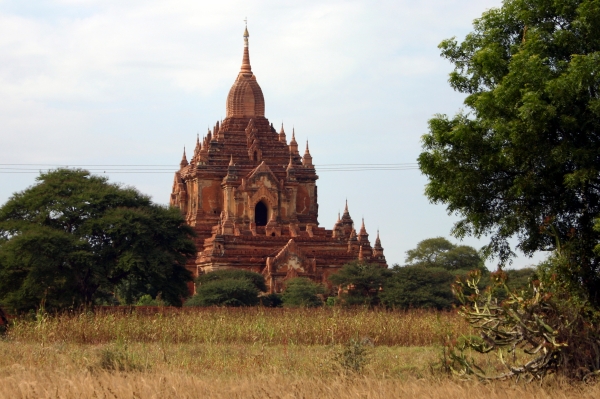 One of the thousands of temples dotting the plain of Bagan.
Unlike its neighbors in Southeast Asia, Myanmar has yet to experience mass tourism. While there are tourists visiting the country, they mainly consists of couples and individual independent travelers. Currently, there are few, if any package group tours to Myanmar. This means that every town you visit still retains a unique sense of place. There are no "could be anywhere" destinations such as you'll find in Thailand and Indonesia. In many respects, Myanmar is still very much a place where the past is still a real presence, rather than a sanitized and commercialized version of it.
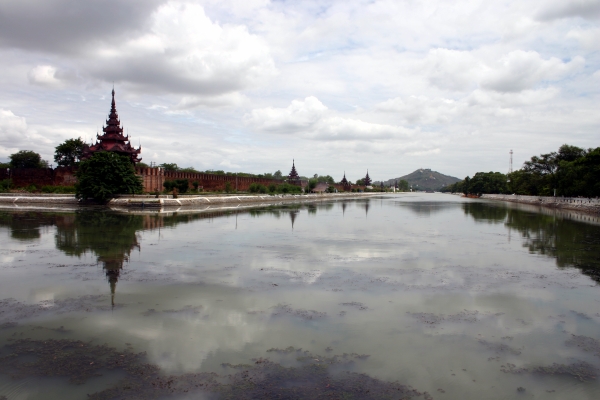 Mandalay Palace, with the temple-studded hill in the background
Adding to the uniqueness is the fact that sanctions have, up to now, kept almost all western brands out of the country. You won't find McDonalds, KFC, Starbucks or any other fast food chains, nor will you find most hotel brands. Everything is local in Myanmar.
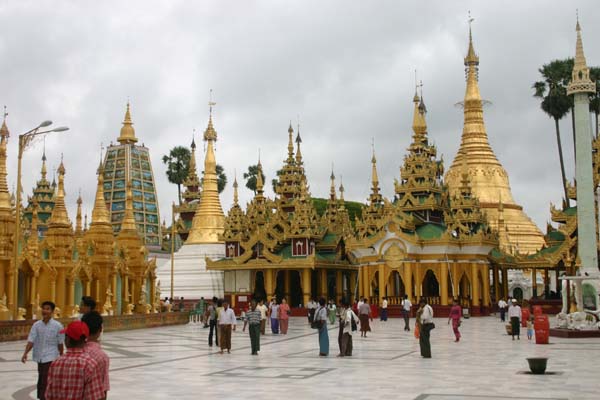 Shwedagon Pagoda in Yangon
The last, but certainly not least, reason to visit is the Burmese people. While news reports may have you expecting a starving downtrodden people, the reality is far different. While they're not exactly dancing in the streets, everywhere you go you will see people going about their business, with authority figures a rare sight.
To Go or Not To Go
Prior to the elections of 2011, which introduced at least a partial democracy for the first time in nearly 50 years, the question of going or not was a difficult one. Now it seems that Myanmar is very much the 'next' popular destination, and there's very little discussion about whether or not it's 'right' to go. While one could argue that the elections are little more than window dressing, it still appears that western governments will soon drop their sanctions, so it could be time to go, before the invasion of western brands.
It must also be said that the country is getting easier to visit. In the recent past, there have been many barriers to getting there and getting around, such as the requirement to obtain a visa in advance, exchanging money at ridiculous rates, etc. These barriers are slowly falling.